

MCP server overview
<p align=“center”> <a href=“https://dbhub.ai/” target=“_blank”> <picture> <img src=“https://raw.githubusercontent.com/bytebase/dbhub/main/resources/images/logo-full.webp” width=“50%”> </picture> </a> </p>
<p align=“center”> <a href=“https://cursor.com/install-mcp?name=dbhub&config=eyJjb21tYW5kIjoibnB4IEBieXRlYmFzZS9kYmh1YiIsImVudiI6eyJUUkFOU1BPUlQiOiJzdGRpbyIsIkRTTiI6InBvc3RncmVzOi8vdXNlcjpwYXNzd29yZEBsb2NhbGhvc3Q6NTQzMi9kYm5hbWU%2Fc3NsbW9kZT1kaXNhYmxlIiwiUkVBRE9OTFkiOiJ0cnVlIn19”><img src=“https://cursor.com/deeplink/mcp-install-dark.svg” alt=“Add dbhub MCP server to Cursor” height=“32” /></a> </p>
DBHub is a universal database gateway implementing the Model Context Protocol (MCP) server interface. This gateway allows MCP-compatible clients to connect to and explore different databases.
 +------------------+    +--------------+    +------------------+
 |                  |    |              |    |                  |
 |                  |    |              |    |                  |
 |  Claude Desktop  +--->+              +--->+    PostgreSQL    |
 |                  |    |              |    |                  |
 |  Cursor          +--->+    DBHub     +--->+    SQL Server    |
 |                  |    |              |    |                  |
 |  Other Clients   +--->+              +--->+    SQLite        |
 |                  |    |              |    |                  |
 |                  |    |              +--->+    MySQL         |
 |                  |    |              |    |                  |
 |                  |    |              +--->+    MariaDB       |
 |                  |    |              |    |                  |
 |                  |    |              +--->+    Oracle        |
 |                  |    |              |    |                  |
 +------------------+    +--------------+    +------------------+
      MCP Clients           MCP Server             Databases
Demo HTTP Endpoint
https://demo.dbhub.ai/message connects a sample employee database. You can point Cursor or MCP Inspector to it to see it in action.
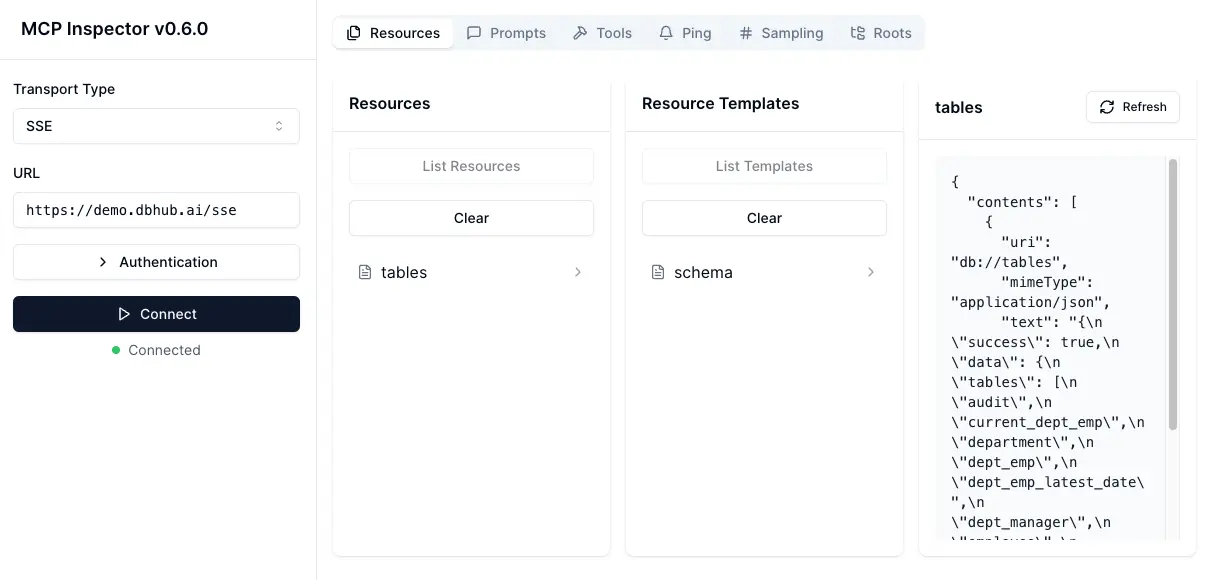
Supported Matrix
Database Resources
| Resource Name | URI Format | PostgreSQL | MySQL | MariaDB | SQL Server | SQLite | Oracle |
|---|---|---|---|---|---|---|---|
| schemas | db://schemas |
✅ | ✅ | ✅ | ✅ | ✅ | ✅ |
| tables_in_schema | db://schemas/{schemaName}/tables |
✅ | ✅ | ✅ | ✅ | ✅ | ✅ |
| table_structure_in_schema | db://schemas/{schemaName}/tables/{tableName} |
✅ | ✅ | ✅ | ✅ | ✅ | ✅ |
| indexes_in_table | db://schemas/{schemaName}/tables/{tableName}/indexes |
✅ | ✅ | ✅ | ✅ | ✅ | ✅ |
| procedures_in_schema | db://schemas/{schemaName}/procedures |
✅ | ✅ | ✅ | ✅ | ❌ | ✅ |
| procedure_details_in_schema | db://schemas/{schemaName}/procedures/{procedureName} |
✅ | ✅ | ✅ | ✅ | ❌ | ✅ |
Database Tools
| Tool | Command Name | Description | PostgreSQL | MySQL | MariaDB | SQL Server | SQLite | Oracle |
|---|---|---|---|---|---|---|---|---|
| Execute SQL | execute_sql |
Execute single or multiple SQL statements (separated by semicolons) | ✅ | ✅ | ✅ | ✅ | ✅ | ✅ |
Prompt Capabilities
| Prompt | Command Name | PostgreSQL | MySQL | MariaDB | SQL Server | SQLite | Oracle |
|---|---|---|---|---|---|---|---|
| Generate SQL | generate_sql |
✅ | ✅ | ✅ | ✅ | ✅ | ✅ |
| Explain DB Elements | explain_db |
✅ | ✅ | ✅ | ✅ | ✅ | ✅ |
Installation
Docker
# PostgreSQL example
docker run --rm --init \
   --name dbhub \
   --publish 8080:8080 \
   bytebase/dbhub \
   --transport http \
   --port 8080 \
   --dsn "postgres://user:password@localhost:5432/dbname?sslmode=disable"
# Demo mode with sample employee database
docker run --rm --init \
   --name dbhub \
   --publish 8080:8080 \
   bytebase/dbhub \
   --transport http \
   --port 8080 \
   --demo
# Oracle example
docker run --rm --init \
   --name dbhub \
   --publish 8080:8080 \
   bytebase/dbhub \
   --transport http \
   --port 8080 \
   --dsn "oracle://username:password@localhost:1521/service_name"
# Oracle example with thick mode for connecting to 11g or older
docker run --rm --init \
   --name dbhub \
   --publish 8080:8080 \
   bytebase/dbhub-oracle-thick \
   --transport http \
   --port 8080 \
   --dsn "oracle://username:password@localhost:1521/service_name"
NPM
# PostgreSQL example
npx @bytebase/dbhub --transport http --port 8080 --dsn "postgres://user:password@localhost:5432/dbname?sslmode=disable"
# Demo mode with sample employee database
npx @bytebase/dbhub --transport http --port 8080 --demo
Note: The demo mode includes a bundled SQLite sample “employee” database with tables for employees, departments, salaries, and more.
Claude Desktop
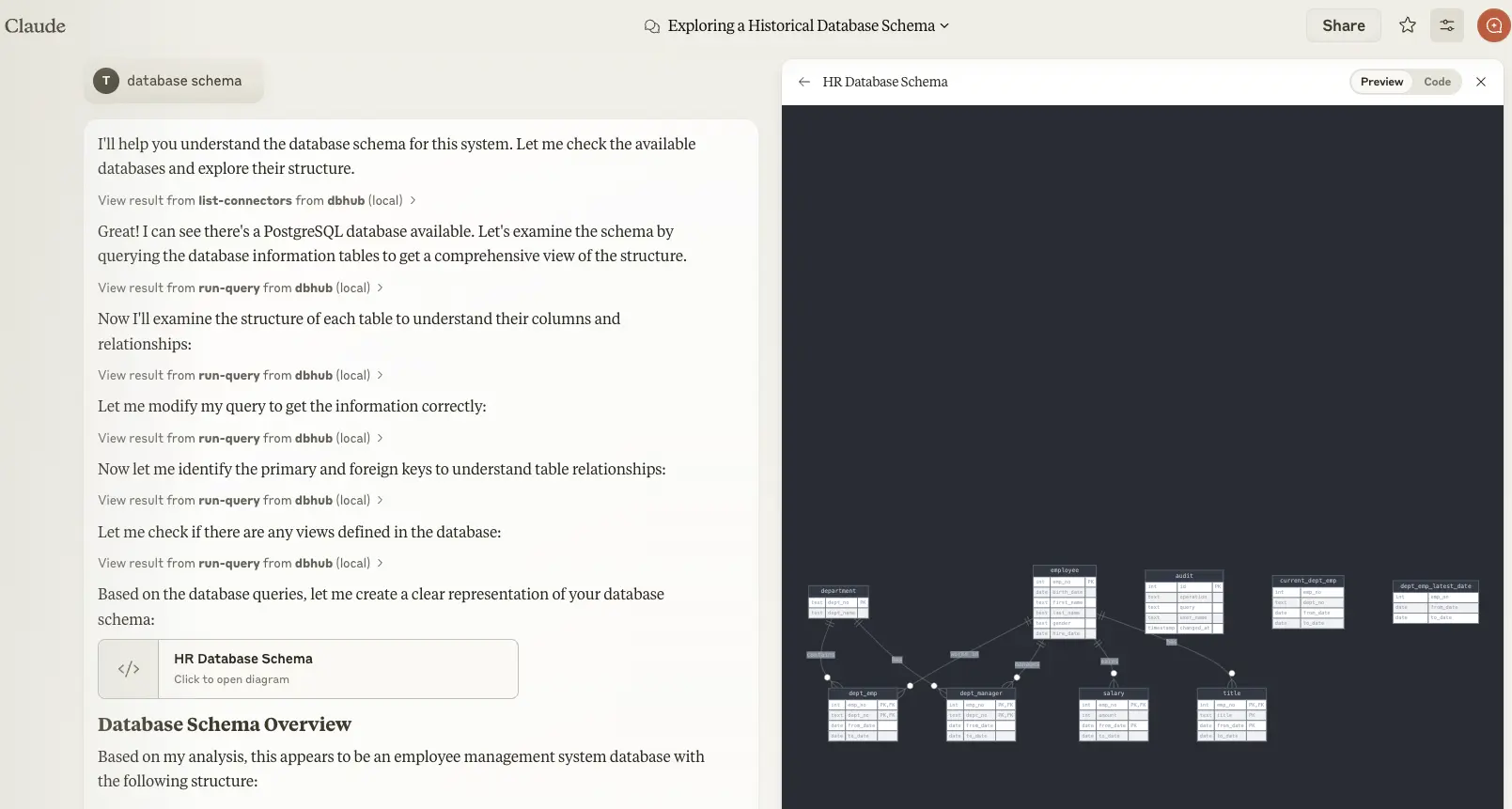
- Claude Desktop only supports
stdiotransport https://github.com/orgs/modelcontextprotocol/discussions/16
// claude_desktop_config.json
{
  "mcpServers": {
    "dbhub-postgres-docker": {
      "command": "docker",
      "args": [
        "run",
        "-i",
        "--rm",
        "bytebase/dbhub",
        "--transport",
        "stdio",
        "--dsn",
        // Use host.docker.internal as the host if connecting to the local db
        "postgres://user:password@host.docker.internal:5432/dbname?sslmode=disable"
      ]
    },
    "dbhub-postgres-npx": {
      "command": "npx",
      "args": [
        "-y",
        "@bytebase/dbhub",
        "--transport",
        "stdio",
        "--dsn",
        "postgres://user:password@localhost:5432/dbname?sslmode=disable"
      ]
    },
    "dbhub-demo": {
      "command": "npx",
      "args": ["-y", "@bytebase/dbhub", "--transport", "stdio", "--demo"]
    }
  }
}
Cursor

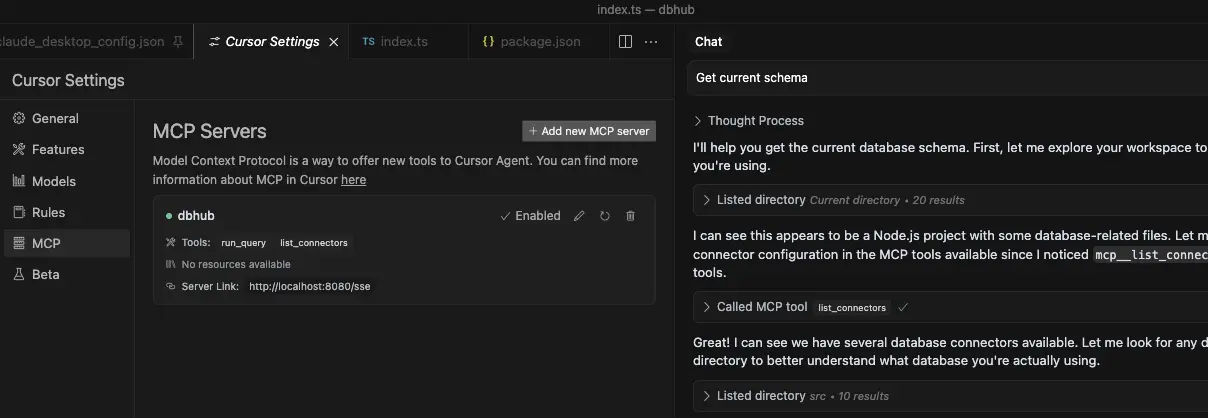
- Cursor supports both
stdioandhttp. - Follow Cursor MCP guide and make sure to use Agent mode.
Usage
SSL Connections
You can specify the SSL mode using the sslmode parameter in your DSN string:
| Database | sslmode=disable |
sslmode=require |
Default SSL Behavior |
|---|---|---|---|
| PostgreSQL | ✅ | ✅ | Certificate verification |
| MySQL | ✅ | ✅ | Certificate verification |
| MariaDB | ✅ | ✅ | Certificate verification |
| SQL Server | ✅ | ✅ | Certificate verification |
| Oracle | ✅ | ✅ | N/A (use Oracle client config) |
| SQLite | ❌ | ❌ | N/A (file-based) |
SSL Mode Options:
sslmode=disable: All SSL/TLS encryption is turned off. Data is transmitted in plaintext.sslmode=require: Connection is encrypted, but the server’s certificate is not verified. This provides protection against packet sniffing but not against man-in-the-middle attacks. You may use this for trusted self-signed CA.
Without specifying sslmode, most databases default to certificate verification, which provides the highest level of security.
Example usage:
# Disable SSL
postgres://user:password@localhost:5432/dbname?sslmode=disable

# Require SSL without certificate verification
postgres://user:password@localhost:5432/dbname?sslmode=require

# Standard SSL with certificate verification (default)
postgres://user:password@localhost:5432/dbname
Read-only Mode
You can run DBHub in read-only mode, which restricts SQL query execution to read-only operations:
# Enable read-only mode
npx @bytebase/dbhub --readonly --dsn "postgres://user:password@localhost:5432/dbname"
In read-only mode, only readonly SQL operations are allowed.
This provides an additional layer of security when connecting to production databases.
Configure your database connection
You can use DBHub in demo mode with a sample employee database for testing:
npx @bytebase/dbhub --demo
[!WARNING] If your user/password contains special characters, you need to escape them first. (e.g.
pass#wordshould be escaped aspass%23word)
For real databases, a Database Source Name (DSN) is required. You can provide this in several ways:
-
Command line argument (highest priority):
npx @bytebase/dbhub --dsn "postgres://user:password@localhost:5432/dbname?sslmode=disable" -
Environment variable (second priority):
export DSN="postgres://user:password@localhost:5432/dbname?sslmode=disable" npx @bytebase/dbhub -
Environment file (third priority):
- For development: Create
.env.localwith your DSN - For production: Create
.envwith your DSN
DSN=postgres://user:password@localhost:5432/dbname?sslmode=disable - For development: Create
[!WARNING] When running in Docker, use
host.docker.internalinstead oflocalhostto connect to databases running on your host machine. For example:mysql://user:password@host.docker.internal:3306/dbname
DBHub supports the following database connection string formats:
| Database | DSN Format | Example |
|---|---|---|
| MySQL | mysql://[user]:[password]@[host]:[port]/[database] |
mysql://user:password@localhost:3306/dbname?sslmode=disable |
| MariaDB | mariadb://[user]:[password]@[host]:[port]/[database] |
mariadb://user:password@localhost:3306/dbname?sslmode=disable |
| PostgreSQL | postgres://[user]:[password]@[host]:[port]/[database] |
postgres://user:password@localhost:5432/dbname?sslmode=disable |
| SQL Server | sqlserver://[user]:[password]@[host]:[port]/[database] |
sqlserver://user:password@localhost:1433/dbname?sslmode=disable |
| SQLite | sqlite:///[path/to/file] or sqlite:///:memory: |
sqlite:///path/to/database.db, sqlite:C:/Users/YourName/data/database.db (windows) or sqlite:///:memory: |
| Oracle | oracle://[user]:[password]@[host]:[port]/[service_name] |
oracle://username:password@localhost:1521/service_name?sslmode=disable |
Oracle
If you see the error “NJS-138: connections to this database server version are not supported by node-oracledb in Thin mode”, you need to use Thick mode as described below.
Docker
Use bytebase/dbhub-oracle-thick instead of bytebase/dbhub docker image.
npx
- Download and install Oracle Instant Client for your platform
- Set the
ORACLE_LIB_DIRenvironment variable to the path of your Oracle Instant Client:
# Set environment variable to Oracle Instant Client directory
export ORACLE_LIB_DIR=/path/to/instantclient_19_8

# Then run DBHub
npx @bytebase/dbhub --dsn "oracle://username:password@localhost:1521/service_name"
SQL Server
Extra query parameters:
authentication
authentication=azure-active-directory-access-token. Only applicable when running from Azure. See DefaultAzureCredential.
Transport
-
stdio (default) - for direct integration with tools like Claude Desktop:
npx @bytebase/dbhub --transport stdio --dsn "postgres://user:password@localhost:5432/dbname?sslmode=disable" -
http - for browser and network clients:
npx @bytebase/dbhub --transport http --port 5678 --dsn "postgres://user:password@localhost:5432/dbname?sslmode=disable"
Command line options
| Option | Environment Variable | Description | Default |
|---|---|---|---|
| dsn | DSN |
Database connection string | Required if not in demo mode |
| transport | TRANSPORT |
Transport mode: stdio or http |
stdio |
| port | PORT |
HTTP server port (only applicable when using --transport=http) |
8080 |
| readonly | READONLY |
Restrict SQL execution to read-only operations | false |
| demo | N/A | Run in demo mode with sample employee database | false |
The demo mode uses an in-memory SQLite database loaded with the sample employee database that includes tables for employees, departments, titles, salaries, department employees, and department managers. The sample database includes SQL scripts for table creation, data loading, and testing.
Development
-
Install dependencies:
pnpm install -
Run in development mode:
pnpm dev -
Build for production:
pnpm build
pnpm start --transport stdio --dsn "postgres://user:password@localhost:5432/dbname?sslmode=disable"
Testing
The project uses Vitest for comprehensive unit testing:
- Run all tests:
pnpm test - Run tests in watch mode:
pnpm test:watch
Pre-commit Hooks (for Developers)
The project includes pre-commit hooks to run tests automatically before each commit:
-
After cloning the repository, set up the pre-commit hooks:
./scripts/setup-husky.sh -
This ensures the test suite runs automatically whenever you create a commit, preventing commits that would break tests.
Debug with MCP Inspector
stdio
# PostgreSQL example
TRANSPORT=stdio DSN="postgres://user:password@localhost:5432/dbname?sslmode=disable" npx @modelcontextprotocol/inspector node /path/to/dbhub/dist/index.js
HTTP
# Start DBHub with HTTP transport
pnpm dev --transport=http --port=8080

# Start the MCP Inspector in another terminal
npx @modelcontextprotocol/inspector
Connect to the DBHub server /message endpoint
Contributors
<a href=“https://github.com/bytebase/dbhub/graphs/contributors”> <img src=“https://contrib.rocks/image?repo=bytebase/dbhub” /> </a>